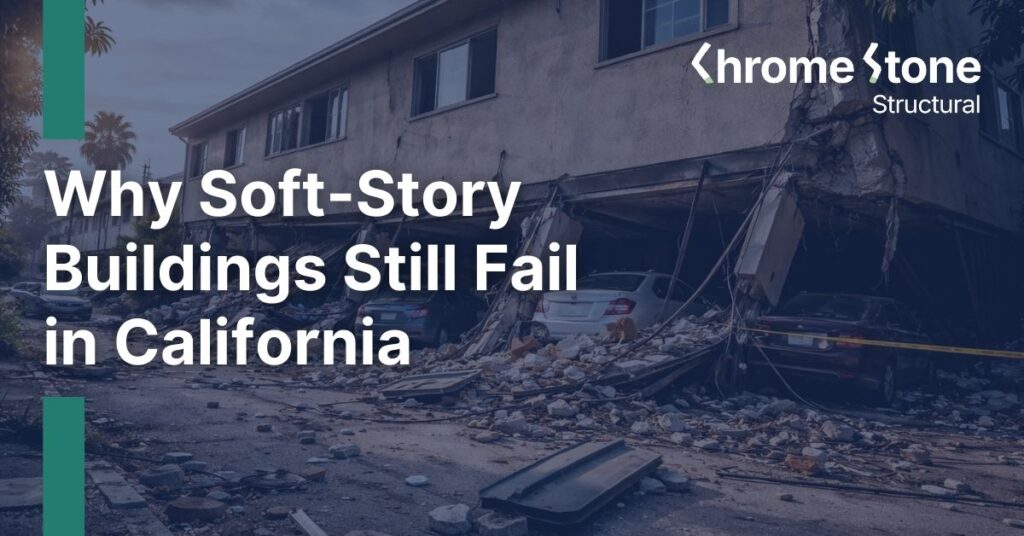
Why Soft-Story Buildings Still Fail in California
Soft-story buildings have been a known risk in California for decades.
Yet failures still happen.
Even after regulations, retrofit programs, and increased awareness, some buildings continue to perform poorly during earthquakes. The issue isn’t lack of knowledge — it’s how that knowledge is applied.
A proper seismic retrofit California approach is not just about meeting requirements. It’s about understanding how the building actually behaves under stress.
What Makes a Building “Soft-Story”?
A soft-story building typically has an open or weak ground level compared to the floors above.
Common examples include:
- Ground-floor parking with open fronts
- Retail spaces with large openings
- Buildings with minimal lateral support at the base
This creates an imbalance. When seismic forces hit, the upper floors remain relatively rigid while the ground level absorbs most of the movement.
That’s where failure begins.
Why Some Earthquake Retrofit Buildings Still Fail
Not all earthquake retrofit buildings perform equally. Some are strengthened effectively. Others still remain vulnerable.
Here’s why:
1. Partial Retrofits
In some cases, only specific areas are reinforced while other weak points remain.
Structural systems work as a whole. Strengthening one part without addressing the entire load path can create new stress concentrations elsewhere.
2. Outdated Structural Assumptions
Older retrofit methods may not reflect current seismic understanding or updated California building codes.
As seismic design evolves, older solutions may no longer provide adequate performance under modern standards.
3. Poor Load Path Continuity
A building must transfer seismic forces from the top all the way to the foundation.
If that load path is interrupted — even slightly — the structure becomes vulnerable.
A complete seismic retrofit California strategy ensures continuous load transfer throughout the building.
4. Design Without Performance Consideration
Some retrofits focus on meeting minimum code requirements rather than actual performance.
But compliance doesn’t always equal resilience.
A building may pass inspection — and still perform poorly under real earthquake conditions.
The California Factor: Why It Matters More Here
California’s seismic environment makes soft-story performance critical.
Buildings must handle:
- Lateral movement
- Ground acceleration
- Repeated stress cycles
- Long-term structural fatigue
This is why structural planning in California goes beyond basic reinforcement.
It requires a deeper understanding of how buildings respond dynamically — not just statically.
What a Proper Seismic Retrofit Should Achieve
An effective retrofit does more than strengthen a single element.
It ensures:
- Balanced structural stiffness
- Continuous load paths
- Reinforced ground-level support
- Compatibility between new and existing systems
- Compliance with current building codes
At Chrome Stone, we approach retrofit projects with performance in mind — not just compliance.
Whether working on residential buildings, commercial structures, or larger facilities, the goal remains consistent:
Low cost – Less time – High quality
But never at the expense of structural safety.
Own or Manage a Soft-Story Building?
If your building includes open ground floors, large openings, or older structural systems, it may be at risk.
Before relying on previous upgrades or assumptions, it’s worth reviewing the structural system based on current standards.
Our team can assess existing conditions and provide structural recommendations aligned with California seismic requirements.
Fill out our consultation form to review your building and understand whether your current retrofit strategy is truly effective.
Frequently Asked Questions
What is a soft-story building?
A soft-story building has a weaker or more flexible ground floor compared to upper levels, making it vulnerable during earthquakes.
Are all soft-story buildings unsafe?
Not necessarily. Properly retrofitted buildings can perform well, but older or incomplete retrofits may still pose risks.
What is seismic retrofit in California?
It is the process of strengthening existing buildings to improve their performance during earthquakes and meet current safety standards.
Why do some retrofitted buildings still fail?
Failures can result from incomplete retrofits, poor load path design, or outdated structural methods.
When should a soft-story building be evaluated?
If the building was constructed before modern seismic codes or has not been recently reviewed, a structural evaluation is recommended.